


HERE ARE SOME SNAPSHOTS for your Thursday.
 (Above) Plains Indian Drum, via here.
 (Above) Round rock, man in the moon. Collection of John Foster.
 (Above) Painted Vinyl Record. Via Yimmyayo.
 (Above) Abstract round table cover; Swen velvets and corduroy. Mid-20th century, 47”. Via Oddfellows Antiques
 (Above) Medical Model of Female; early 20th century.
 (Above) Early Prosthetic Leg; Hand-formed aluminum with flush aircraft rivets.
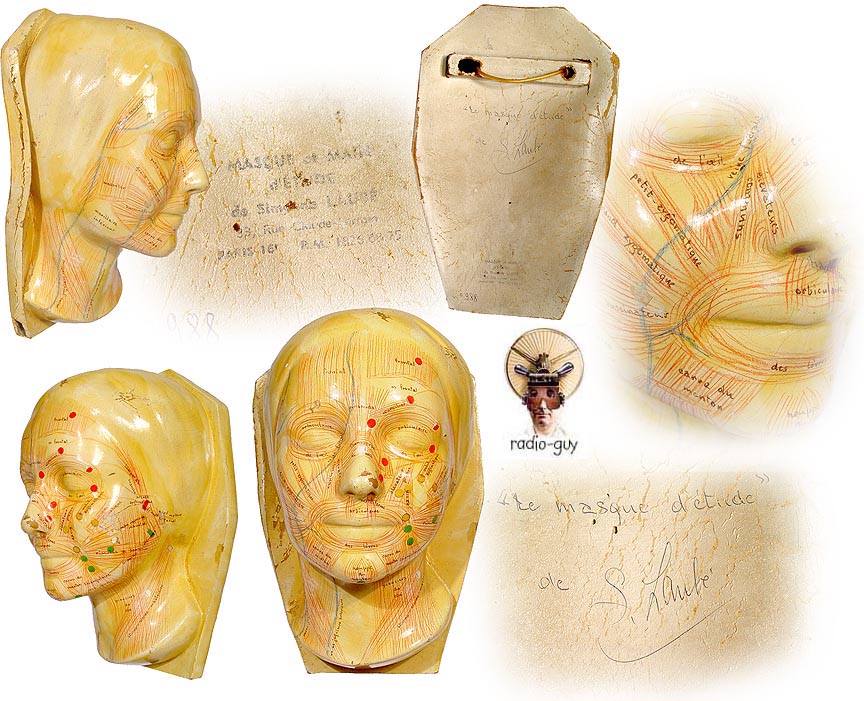 (Above) Beautiful and Delicately Sculpted Face for Medical Study: Cast in hollow hard rubber with a lacquer finish. The highly detailed front is hand-drawn and labeled with facial muscles. Made in France, the back is signed. It reads “le masque d’etude”, S. Laule....

 (Above) My Bicycle Book, saddle stitched, published by the Board of Education, Palo Alto, CA, 1941, Via Ampersand Vintage. Click image for larger view.
 (Above) Ceramic pot by Rudy Autio (1926 - 2007), via here. Click for larger view.
 (Above) Collection of 16 Balsa Wood Model Airplane Ribs, c. 1940-1950. Via Heir Antiques. Click for larger view.
 (Above) Collection of 12 pressed steel children’s tricycle seats. Via Lost Found Art. Click for larger view.
 (Above) Laszlo Moholy-Nagy, photogram. 1923; Silver print. Collection of Charles Isaacs, via Luminous Lint. Click for larger view.
 (Above) “HAY..............For Sale.” Via Candler Arts. Click for larger view.
 (Above) Monkey skull from Africa; covered in mud and raffia. Circa 1925. Via Historia Antiques. Click for larger view.
 (Above) Hugh Joseph Ward (American, 1909 - 1945). The Evil Flame, Spicy Mystery Stories pulp cover, August 1936. 28.5 x 19.5 inches; Oil on canvas; Sold for $143,400.00
 (Above) Margaret Brundage (American, 1900 - 1976). A Rival From the Grave, Weird Tales illustration, January 1936; 20 x 13.5 inches; Pastel on paper board. Sold for $37,344.00
 (Above) Robert Fuqua (American, 20th century). Revolt of the Robots, Fantastic Adventures pulp illustration. First Issue, May 1030; Sold for $27,485.00
 (Above) Frank R. Paul (American, 1884 - 1963). The Robot Aliens , Wonder Stories pulp cover, February 1935. Oil on canvas. Sold for $19,120.00.


 (Above) Li Xiaofeng sits with two of his extraordinary works.
 Click any image for larger view.
 Click any image for larger view.


