Monday, March 23, 2009

The Art of Ernst Haeckel

(click any image for larger view)


ERNST HAECKEL (1834 – 1919) WAS A GERMAN BIOLOGIST, NATURALIST, philosopher, physician, professor and artist. With all of these professions, he left something for for all of us. His famous book, “Kunstformer der Natur” is the source for these incredible engravings. Enjoy.

Saturday, March 21, 2009

The Age Maps of Bobby Neel Adams


Click any image for larger view.


Bobby Neel Adams was born in Black Mountain, NC, a magical place as the former home to the Bauhaus. Working without the aid of digital imaging, and by tearing and gluing the pictures, he creates what he calls “Age Maps,” the kind of thing forensic artists might use to discover what someone might look like who has not been seen for some time. It’s an interesting concept.

Adam’s work is held in the collections of ICP (International Center for Photography), the Houston Museum of Fine Art, the Norton Family Foundation, the USB Collection, DiRosa Ranch and the Greenville Museum of Art.

Friday, March 20, 2009

A Very Fine Lady From Italy

Click any image for larger view.


HERE’S A VERY FINE 18th CENTURY TUSCAN “Santa Maria” Figure from Italy, with beautiful inset glass eyes, cloth wrapped arms and finely sculpted hands. It’s beautifully carved and polychromed wood, displayed on an early chestnut wood base makes this piece a wonderful item for any collection. The dealer is asking $12,000 for her—maybe that is why she looks so worried.

Dimensions: 24 inches tall.
Overall condition is excellent.
Measurements -- height: 60.96 cm (2 ft.)

Colonial Arts
1028 Kearny Street
San Francisco, CA 94133
Phone: 415-505-0680
E-Mail: info@colonialarts.com

Thursday, March 19, 2009

A Dandy Man From France

Click any image for a larger view.


HERE’S A LIFE-SIZED, MALE WAX HEAD, 1920s FRANCE that I consider to be incredible. Think of the French artisan who made this... using real human hair, piercing blue eyes made of glass and porcelain teeth—reveling in getting every detail just right. This life-like object was probably used as a display for fabric collars and bow ties in a haberdashery shop. It stands just over 2 feet tall, and is mounted on a marble base. The condition appears to be excellent. My only suggestion—he could use some teeth whitening.

Stay tuned tomorrow, when you’ll get to see “A Very Fine Lady From Italy.” Maybe they’ll get together.

To learn more about this object (like the price), you’ll have to contact the dealer:
Robollo Home
1776 18th Street
San Francisco, CA 94107

Phone: 415-575-1776

E-Mail: info@robollo.com

Wednesday, March 18, 2009

Photobooth Images By a Self-Taught Artist

(Above) Lee Godie (1908 - 1995), a homeless artist in Chicago, photographed on Michigan Avenue with some of her rolled up paintings. Photo © Steve Kagan
(Above) “Lee Godie-This is a Kid’s Pose,” 4 x 5” photobooth image (titled on verso)
(Above) “Lee-A Girl With Roses” 4 x 5” photobooth image (titled on verso)
(Above) “Lee In a Camera,” 4 x 5” photobooth image
(Above) “Lee as an Artist,” 4 x 5” photobooth image
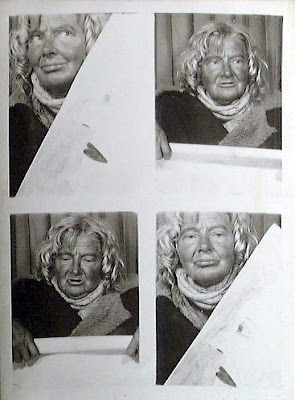
(Above) “Lee with a Paper,” 4 x 5” photobooth image
(Above) “Lee,” 4 x 5” photobooth image

I NEVER HAD THE OPPORTUNITY TO MEET LEE GODIE. She passed away in 1995, not so long ago, really. Even if you were from her hometown of Chicago, I have heard that finding Lee Godie was never easy. She was homeless, and though she often sold her paintings on the steps of the Chicago Art Institute, on North Michigan Avenue or Water Tower Park, you could never be sure what day she’d be there. And then, assuming you spotted her, there was no guarantee she would even talk to you, much less sell you an artwork. There were rumors she didn’t like fair-haired people. And for whatever reason, if she didn’t like you, or your approach to her was not to her liking, there was no amount of money you could offer her to get her to sell you a painting. You were just out of luck. NO SOUP FOR YOU!

She did, however, really like Chicago art dealer Carl Hammer. She often stopped by his art gallery, and they had a special relationship of mutual respect. He was one of the first art dealers to carry and sell her artwork.

Besides being a painter, she also used the photo booth machine at the Trailway’s Bus Station as part of her art making process. Without question, she was creating photographically altered self-portraits before the famous contemporary photographer Cindy Sherman was doing it. Ms. Godie would actually rub paint or other substances on her face to darken it before she stepped into the photo booth. She would wear various costumes to change her identity. And, she was definitely aware of the “totality” of the image when stepped into the photo-making booth. For example, when she chose the “four small images” instead of the one “large” image—it was a conscious decision. You can see that in the the photo above entitled “Lee in a Camera.” There, Godie had to quickly remove herself from the booth between “takes” so that she would have blank spaces in which to write. Check it out. That was an aesthetic decision. After the image was developed, she would often enhance the features of her face with red paint or ball point pen.

Godie’s photographs are rare, and most, if not all, are in private collections.

Intuit, the Center for Intuitive and Outsider Art in Chicago recently held an exhibition of over 100 pieces of Lee Godie’s work, and was entitled “Finding Beauty: The Art of Lee Godie” (September 12, 2008 - January 3, 2009). This superb show was co- curated by Jessica Moss and David Syrek (who designed the catalog) that’s available for $10. You can read more about Lee Godie here. If you are a fan of self-taught art, joining Intuit is a must— and you get a subscription to their magazine, The Outsider. Check it out!

Tuesday, March 17, 2009

An ‘Artist/Soldier’s’ Past Time

(Above) Welsh Dragon
Description: Shell casing flower vase made from German 77mm shell. Embossed figure of Welsh dragon with embossed background. Bottom of shell crimped. Top of shell crimped and flared. Shell dated September 1914 on headstamp. 8” tall.
(Above) Statue of Liberty
Description: Decorated shell casing made from American 3pdr naval shell. Statue of Liberty motif with three birds in flight on reverse. Shell dated 1898 on headstamp. 12” tall.
(Above left) Bird and Coyote
Description: Shell casing flower vase made from French 105mm shell. Bird in tree, flower, coyote, and date 1919 in relief. Embossed background. Shell dated 1918 on headstamp. 15” tall.

(Above right) Grape Vase
Description: Shell casing flower vase made from French 75mm shell. Floral motif with grapes and grape leaves. Top scalloped incorporating leaf patterns. Engraved leaves with embossed background. Shell dated 1916 on headstamp. 12” tall.
(Above) Argonne Vase
Description: Shell casing flower vase made from French 75mm shell. Poppy motif and ‘Argonne’ in relief with embossed background. Scalloped top and twisted fluting on bottom half of shell casing. Shell dated 1916 on headstamp. 13 1/2” tall.
(Above) Larger Floral Vase
Description: Decorated shell casing made from German 210mm shell. Embossed floral motif within two bands. Scalloped top. Shell dated May 1917 on headstamp. 9 1/2” tall.

WITH NEARLY 30 YEARS OF COLLECTING OBJECTS, including folk art, I have often seen examples of “trench art,” an art form largely practiced during WWI but certainly continued during WWII. I always had a rather romantic view of the art form—that of soldiers sitting in muddy trenches during a lull in the action hammering a spent brass shell into something beautiful, turning killing tools into something beautiful for a loved one back home.

Certainly, some objects could have been made while actually in the trenches (whittled wood carvings, etc.) but the reality of these brass artillery shells being hammered into art while on the front lines is largely a myth. More than likely they were made well behind the front, while a soldier was at rest. Sometimes, objects like this were made as a theraputic past time when convalescing from wounds or illness. In terms of raw material, brass shell casings were more than plentiful.

Likely scenarios are that the “soldier/artists” made these objects and sold them to other soldiers; that local artisans in nearby towns made them to sell to other soldiers for gifts back home; or possibly they were made by prisoners-of-war in exchange for cigarettes or money.

However they were made, they are lovely examples of folk art with a real story behind them. Look for these the next time you are hitting the flea markets or antique malls. You’ll find them to be more common than you might think.

Learn more about this art form at www.trenchart.org.

Sunday, March 15, 2009

Scouts at Work


(Above) The final logo for the BSA Centennial coming in 2010, was first drawn by Scout Philip Goolkasian, selected as the winner and later finalized with the assistance of graphic design legend Kit Hinrichs.
(Above, from left) Graphic designer Scott Abel, logo-contest winner Philip Goolkasian, and Pentagram partner Kit Hinrichs team up to finalize a symbol for the future.
(Above) Kit Hinrichs, a partner at Pentagram in NY since 1986, happens also to be an Eagle Scout — as well as a Vigil Honor member of the Order of the Arrow.

A WEEK OR SO AGO, I WAS DOING A STUDY ON CENTENNIAL LOGOS, curious about the creative approach many companies and organizations take to show the world they have reached this historic milestone. After all, 100-year anniversaries only come around once, as they say. I hate to see corporations and businesses blow this great opportunity with a weak, ill-planned celebration. Unfortunately, many companies simply slap a ribbon banner across whatever corporate logo they have with the words “Celebrating 100 Years” and call it a day.... or, a century, that is. When I stumbled upon this story about the 100th anniversary of the Boy Scouts of America, and saw that the famous designer Kit Hinrichs was involved, I thought it was worth sharing with my readers. What intrigued me about the Boy Scout logo was the approach they took to get there. They held a contest for active Scouts nationwide.

“We could have hired a well-known, professional graphic design firm to create the logo,” said Robert Mersereau, project director for the 100th anniversary celebration, “but we thought that if our intention was to create a symbol to celebrate the youth of America, we should let youth create it.”

The winner (from over 4,000 entries) was 17-year-old Eagle Scout Philip Goolkasian of Fresno, CA. His reward? He got to work with famed designer Kit Hinrichs for the “final” design. Philip said he was at a football game when he started sketching ideas for the logo but left in the 3rd quarter because his idea was starting to gel. I am sure many of you who are artists know exactly what Philip was feeling.

“The way Philip worked the eagle into the BSA type using negative space and gave every element a distinct hierarchy was quite sophisticated,” Hinrichs said. “The kid has real talent!” Hinrichs suggested that Philip replace his serif font with Futura, and worked with him to tweak the final look.

Philip plans to study architecture in college. So far, he’s applied to Notre Dame and Catholic University, as well as schools in his home state: Cal Poly at San Luis Obispo and Cal Poly Pomona.

You might also like:

Related Posts Plugin for WordPress, Blogger...